🛡️ Safety and structure
Snow loads in Negrești, Vaslui, Huși and Bârlad: what CR 1-1-3/2012 says and what it means for the roof
This is a translation. The Romanian version of the article is the reference text.
⚠️ These guides apply only to buildings in Romania. The laws, standards, deadlines, fees and values quoted (Law 169/2026, P 118, CR 1-1-3, the O.A.R. guides) are Romanian; in your own country other rules apply.

The weight of snow is one of the actions a roof structure is designed for. Romania's design code CR 1-1-3/2012 explains how to calculate it, and its Table A.1 gives values for the country's towns and cities, including Negrești. Below are the values for our area and how you get from them to the load on the roof. The calculation is done by the structural engineer; this article does not replace it.
ℹ️ About the source
This article compares two documents: the design code CR 1-1-3/2012 “Evaluation of the snow action on buildings” (Table A.1 and art. 3-4) and the National Annex SR EN 1991-1-3:2005/NA:2006 (ASRO, Table NA.1). For CR 1-1-3/2012 we also saw a draft approval order with the number and date left blank. The two do not give the same values for every town, and we cannot say which edition applies to your project: confirm with your designer.
What the characteristic ground snow load is
The starting point is sk, the characteristic snow load on the ground, defined with a 2% probability of being exceeded in a year, i.e. a mean return period of 50 years (art. 3.1 para. 1). The values in the zoning map (Figure 3.1) are valid for altitudes up to 1,000 m and are minimum values, mandatory for design (para. 3 and 4).
The values for the Vaslui area in the two documents
CR 1-1-3/2012 gives values for 337 towns and cities (Table A.1, art. 3.1 para. 5). The 2006 national annex SR EN 1991-1-3/NA divides places into three zones: zone 1 = 1.5 kN/m², zone 2 = 2.0 kN/m², zone 3 = 2.5 kN/m². For the towns in Vaslui county:
| Town | CR 1-1-3/2012 (kN/m²) | 2006 national annex |
|---|---|---|
| Negrești | 2.5 | zone 3 = 2.5 |
| Vaslui | 2.0 | zone 2 = 2.0 |
| Huși | 2.5 | zone 2 = 2.0 |
| Bârlad | 2.5 | zone 2 = 2.0 |
Why they differ and what to do
In Negrești and Vaslui the two documents agree. In Huși and Bârlad, CR 1-1-3/2012 has a higher value than the 2006 annex. CR 1-1-3/2012 states that the values in the zoning map are minimum values, mandatory for design (art. 3.1 para. 4). Choosing the applicable document is the designer's job; if you have a project in Huși or Bârlad, ask them to state the value used and its source.
The zoning map
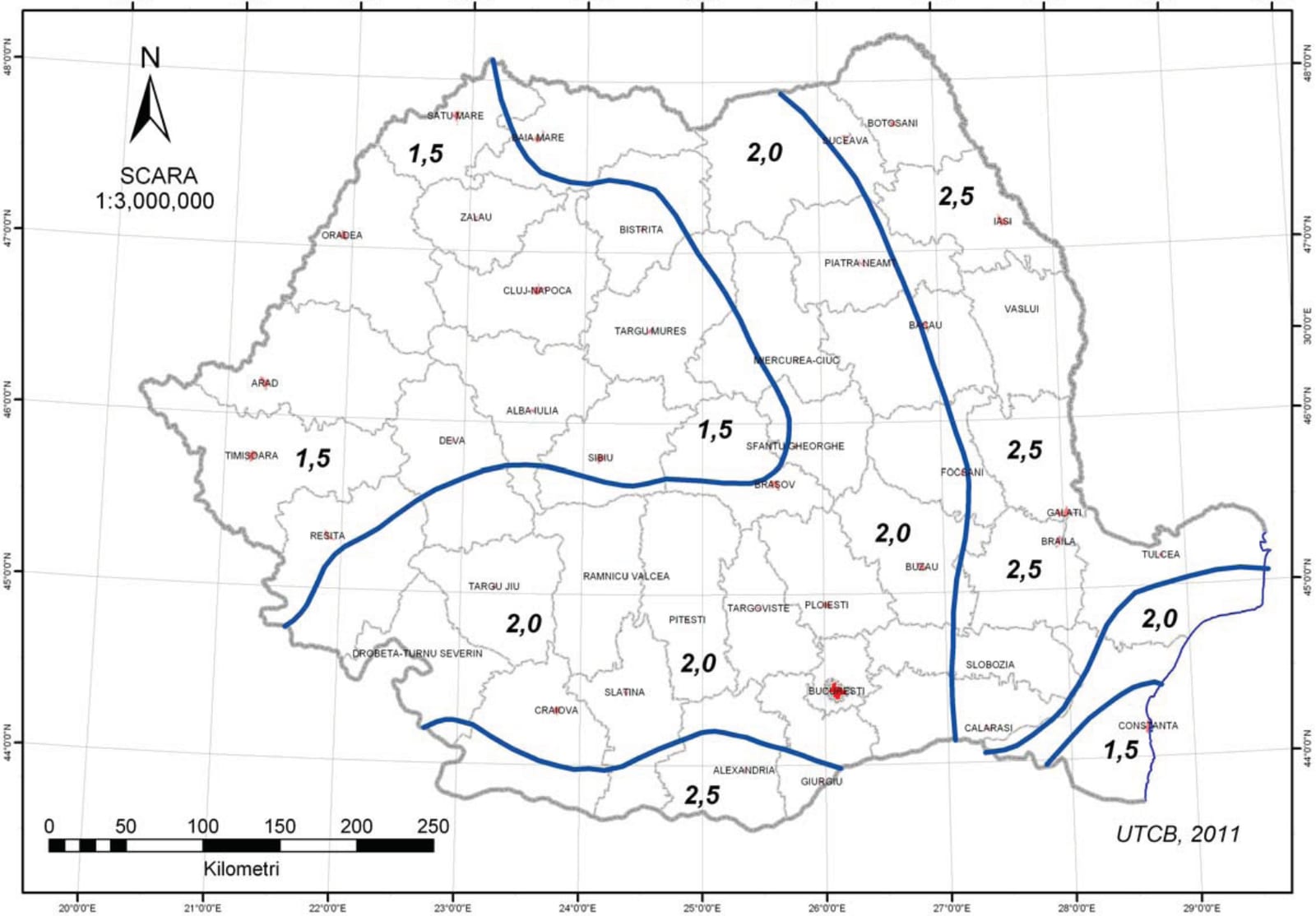
On the map, Vaslui county is in the 2.5 kN/m² zone, like Iași, Galați and Brăila. Negrești, Huși and Bârlad match this zone. For the city of Vaslui, however, Table A.1 gives 2.0, even though the map shows it in the 2.5 zone; the 2006 annex also places it in zone 2 (2.0). Since the map values are minimum and mandatory (art. 3.1 para. 4), ask your designer to state which value they use for Vaslui and what it is based on.
What about the villages?
The tables only include main towns and cities. For a village (Băcești, Rafaila, Todirești and the others), the value is read from the zoning map, together with the designer. We do not infer it here from the table. 2.5 kN/m² means about 250 kg per square metre of ground; the load on the roof is different, as shown below.
From the ground to the roof
The snow load on the roof is obtained by multiplying sk by several coefficients (art. 4): the roof snow load shape coefficient μ (which depends on the shape and pitch of the roof, chapter 5), the exposure coefficient Ce (wind exposure), the thermal coefficient Ct and the importance-exposure factor. Roofs with obstacles or parapets (chapter 7) and snow overhanging the eaves have separate rules. This is why the load on the roof is not equal to the one on the ground and cannot be determined without a calculation.
- the shape and pitch of the roof change the load; see also the shape and pitch recommendations of the O.A.R. guide;
- photovoltaic panels add weight: art. 299 of the Planning Code requires them to be supported by a structure able to carry the loads from their own weight, wind and snow; see the article on photovoltaic panels and P 118.
Informational article based on CR 1-1-3/2012 and the national annex SR EN 1991-1-3/NA:2006 (a summary of the values, without reproducing the documents). The values apply to altitudes up to 1,000 m; the structural design sets the design load. It is not legal advice.
Are you extending, adding an attic or changing the roof of your house?
We check the structure and the snow loads and prepare the design, at your address or remotely.
Contact us